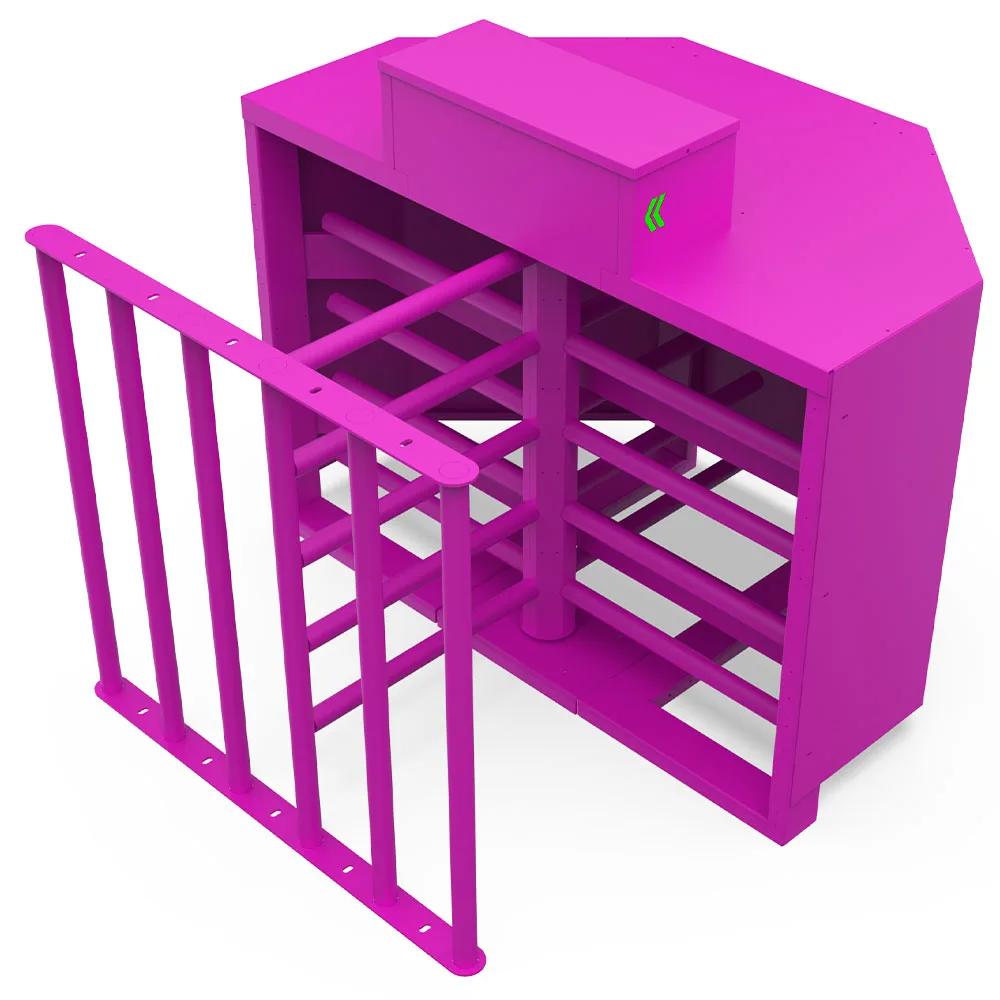
Electromechanical semivertical turniquette: how to choose the right model
An electromechanical semivertical turnike stops the unauthorized passage better than a tripod, without the massive appearance of a full-height cage. The high rotor is unlocked for one person only after access validation. The choice holds height, arms, material and number of passages.
In short: rotor 1100–1300 mm, 3 or 4 arms, painted or stainless steel, single or double variant, controlled by the access control system.
Do you need help choosing?
Tell us what you need and we'll send you the offer on the same working day.
An electromechanical semivertical turnike offers a good compromise between security and visual opening of the entrance. For large flows, double variants save space, and the stainless steel better resists outside. For a staff pass, the 4-arm version at 1300 mm offers a firmer barrier. Check the mounting base, spare power supply and contact with the readers. Then compare Wanzl, Atlas, Tiso and Ozak models in the category Half-height turnstiles.
An electromechanical semivertical turnike controls the passage of pedestrians one by one, with a rotor higher than the arms of a tripod. Basically, the person enters only after the access control system validates the card, code or ticket. Then the rotor is unlocked for a single rotation. In the guide below see how you choose height, number of arms, material and simple or double version.
What does a semivertical electromechanical turnike mean?
The name describes two things. First, the term "semivertical" shows that the rotor covers an important part of man's height, without going up as in full-height models. "Electromecanic" means that an electrically controlled mechanism blocks or releases rotation. In other words, a semi-vertical electromechanical turnstiles receives the impulse from the reader and leaves a single pass.
On ONSEC you find in category Half-height turnstiles Wanzl, Atlas, Tiso and Ozak models. They all start from the same principle, but differ in height, material and number of passages.
Between tripod and full-height
A tripod stops the passage with three short arms, at the waist level. However, a determined person can jump or go around. At the opposite pole, the high vertical turnstiles completely close the passage. The semi-vertical version occupies the middle position. For example, the manufacturer describes the model Ozak HT 400 S 100 as a solution for locations that target more security than a tripod.
So a semi-vertical electromechanical turnike matches where the tripod seems too easy to avoid, but a full-height cage would look too massive. If you need full closure, compare and range of vertical turnstiles.
Height and number of arms
The height directly influences how hard the rotor can climb. The Wanzl Low Atlas series offers, for example, two clear steps:
- Version with 3 arms and height of 1100 mm, such as Wanzl Low Atlas 141 H.
- The 4-arm and 1300 mm height model for a firmer visual barrier.
On the other hand, the 4-axis rotor also appears at the Atlas Buffalo series. At Ozak HT 400, each of the four sections of the rotor has 5 removable arms. Therefore, at a semi-vertical electromechanical turnstiles it matters not only how many arms you see, but also how many bars remain. Several bars reduce the space by which someone would slip his hand or an object.
Single or double: one passage or two
The simple option serves only one access point. Instead, double models put two rotors in the same construction. Thus, you occupy less space than with two separate units. Here are a few pairs in the range:
- Wanzl Low Atlas 141 H and double version 241 H.
- Ozak HT 400 S 100 and double version HT 400 D 100.
- Tiso Cyclone and Cyclone Twin, with two access points.
Especially at staff entrances with high flow in the morning, a semi-vertical electromechanical double turnstile shortens the tails. At the same time, you can dedicate a passage to the entrance and one to the exit.
Connection to the access control system
The rotor doesn't decide who passes. The card reader, keyboard or ticket scanner sends a signal to the control plate. Then the mechanism releases a single rotation, in the required direction. So, pick the readers before the turnstile, so you know where you fix them. For areas with tickets or scoring records, a semivertical turnike shall keep the order at each pass. At the same time, a direction indicator shows the man he's allowed to enter. Useful accessories, such as supports or readers, you find in the category Turnstile accessories.
Material and finishing for a semi-vertical turnike
The material decides how it looks and how much the equipment resists in the chosen environment. Range includes two main directions:
- Steel painted in RAL colours, as in Atlas Buffalo BFC 154.
- Inox, like Atlas Buffalo BFI 154, Wanzl Low Atlas or Ozak HT 400.
The painted version integrates into the colours of the building. In contrast, stainless steel is better resistant to outdoors and frequent cleaning. The Atlas manufacturer mentions for BFI 154 areas such as stadiums and parking lots, in indoor or outdoor environments. However, choose a semi-vertical electromechanical outer turnicet only with a good foundation and protected cables.
Mounting a semivertical turnstile
Category recommends hard surfaces for fixing: concrete, gravel, wood or other bases that allow a solid anchorage. First, check the flatness of the flooring and the path of the cables. Then set where you mount the card reader or code. Later, the electrician links the control to the access control system.
Also think about the spare power supply. Models Cyclone allow, for example, the connection of an external battery to voltage drops. For a semi-vertical electromechanical turnpocket on an important route, the energy reserve avoids blocking. In addition, the escape routes shall be established separately after the project and the requirements of the authorities. General information about evacuation can be found on the website IGSU.
Frequently Asked Questions about Electromechanical Semivertical Turnpike
Where do I set up a semivertical turnstiles?
Inside or outside, on a hard and flat base. For outdoors, choose stainless steel or painted steel with good protection.
How many arms does the rotor have?
Depends on the model. You find 3-arm rotors and 4-axis rotors, and some sections have several detachable bars.
Can it go both ways?
Yes, many models work bidirectionally. For example, Ozak HT 400 S 100 works for entry and exit. Thus, a semivertical electromechanical turnike serves both flows.
What am I doing on a power outage?
Check if the model accepts external battery, as Tiso Cyclone allows. Then, set with the installer how the rotor behaves without tension.
Compare single or double heights, materials and variants in the category Half-height turnstiles. The ONSEC team helps you to match a semi-vertical electromechanical turnstiles with the human flow and your access control system.