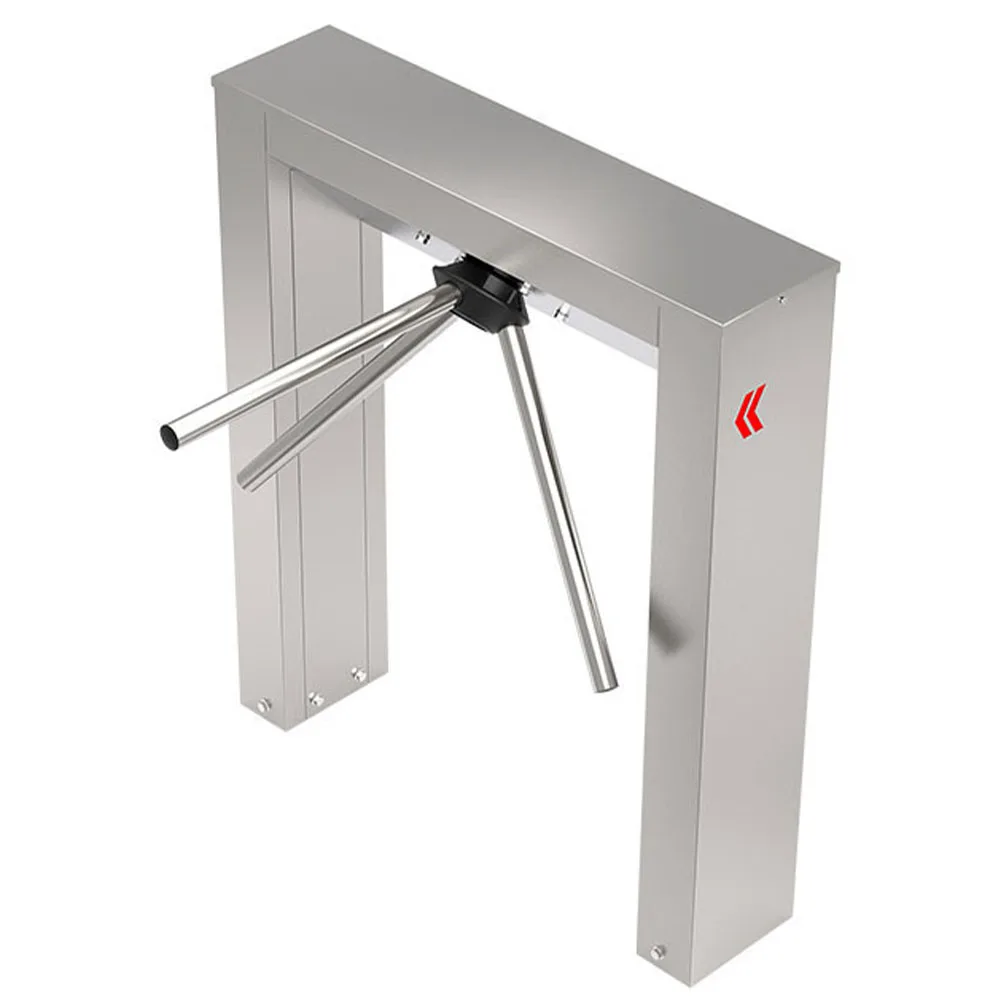
Bidirectional tripod turnstiles: arms, legs and working modes
A bidirectional tripod turniket controls the passage of pedestrians on entry and exit through the same point. The three arms let one person pass each validation. Therefore, equipment often appears in factories, sports rooms, canteens and office buildings with access control.
In short: choose between one leg and two, between fixed and falling arms, then between semi-automated or motorized action, after human flow.
Do you need help choosing?
Tell us what you need and we'll send you the offer on the same working day.
A suitable bidirectional tripod turnstiles starts from the available space and from the number of people at the top of the hour. Then you decide between one leg and two, between fixed and falling arms and between semi-automatic or motorised action. Also check the body material and compatibility with existing readers. Thus, access remains fluid and orderly day by day. Explore Atlas, Came Ozak, Digigon and Lotgate models in the category tripod turnstiles.
A bidirectional tripod turniket has three arms arranged at 120° which rotate on a tilted axis. At each validation, the rotor makes a third rotation and releases the pass for one person. Therefore, the flow of pedestrians becomes orderly, and the access system correctly counts the entrances.
In this article we explain the concrete differences between the models in the category tripod turnstiles. For example, we compare the Atlas Cerberus, Came Ozak, Digigon, Lotgate and Dormakaba series.
Why does a bidirectional tripod turnstiles matter?
A unidirectional model controls only the entry, and the exit remains free or passes through another point. Instead, a bidirectional tripod turniket checks both senses through the same body. So, you save space in the lobby and you have a complete record of the presence. Also, the control board usually allows different settings on each direction. For example, entry requires a card, and exit remains free.
One leg or two: bridge bidirectional tripod
Most turnstiles have one body, mounted next to a wall or a balustrade. However, some models use two legs linked by a cap, i.e. the "bridge" version. Here are examples of the category:
- For example, Atlas Cerberus CRB 200 has two legs, stainless steel body and anodized aluminium arms.
- Then the Came Ozak 700 series uses all the bridge construction from stainless steel.
- Instead, Came Ozak 602-F retains one leg, with falling arms.
The two-legged construction fits in the middle of a hallway without a support wall. On the other hand, the one-legged version takes less place at narrow entrances. So, choose a bidirectional tripod turnstiles after space geometry, not just after appearance.
Falling arms at a bidirectional tripod turnstile
Falling arms, also known as ‘drop-arm', come down when the supply is missing or at an emergency signal. Thus, the passage is completely released for evacuation. For example, Atlas Cerberus CRB 110 includes this function, as well as Came Ozak 602-F. However, a two-way tripod turnstiles with falling arms does not replace the escape routes in the project.
First, the evacuation plan of the building sets the necessary widths and routes. Also, the general rules on fire prevention find them at IGSU. Therefore, discuss the location of the turnstiles with the projector prior to assembly.
Semi-automated or motorized: how to rotate arms
In a semi-automatic model, the person pushes the arm after unlocking, and the mechanism completes the rotation. For example, Atlas Cerberus CRB 100C works like this, with the body in the black painted steel. Instead, a bidirectional motorized tripod turner rotates the arms itself after validation.
Model Lotgate Expert Gold illustrates the motorized version well. Manufacturer indicates 20 persons per minute, 530 mm blocking width and anti-panic function. In addition, the LED indicators from both heads show the permitted direction. At the same time, this two-way tripod uses 24 V DC power, which simplifies the electrical installation.
Material: stainless steel, painted steel or special finishes
The body of the turnstiles bears daily touches, bags and carriages. That's why the material has a lot to do with the appearance after a few years. Here are the options:
- For example, stainless steel appears at Came Ozak, Atlas CRB 200 and Dormakaba Kerberos TPB-L07.
- Then the electrostatic painted carbon steel equips Digigon Catrax Fit and Atlas CRB 100C.
- Instead, the gold finish differentiates Lotgate Expert Gold in prestigious receptions.
At the same time, arms differ as well. For example, Atlas uses anodized aluminium, and Digion Catrax Fit It has stainless steel arms of 470 or 520 mm. So, at any bidirectional tripod check the length of the arms before you set the width of the aisle.
Capability at peak time
The actual flow depends on the speed of the validation, not just the twister. For example, a proximity card validates faster than a typed code. Therefore, when changing the turn of a factory, the color number matters a lot. In addition, a two-way tripod turnstiles serves both senses, but not simultaneously. Thus, at very crowded entrances it deserves two separate colors, one for each sense.
Integration with access control system
A two-way tripod turnstiles doesn't decide who's going through. His plate receives a contact from the reader of QR cards, tags or codes. For example, Came Ozak states that the inputs accept dry contact access control systems. In addition, some models come with chipboard, such as Atlas CRB 100CJR. Thus, you can use tokens at swimming pools, amusement parks or public toilets.
Inside or outside
According to the manufacturer, the Atlas Cerberus series covers both the interior and the exterior. Dormakaba Kerberos TPB-L07 also adapts to both mediums. On the outside, however, it deserves a cover that protects the readers and the rain board. Therefore, the manufacturer also asks about the temperature range in which the mechanism works. For more stringent control, compare and Vertical twists, which completely blocks the height of the passage.
Assembly and maintenance
First, the assembly requires a flat and resistant flooring with solid anchors. Then the electrician brings the power and signal cables from the reader. Later, maintenance means cleaning the body and checking the rotation mechanism. So, a well-mounted bidirectional tripod turnstiles is working for years in a row.
Also, choose a place away from doors that open across the aisle. In addition, leave room for a guide railing, which aligns people to the entrance. Thus, the flow remains orderly even at the turnover, when everyone arrives at once.
Frequently asked questions: bidirectional tripod turnstile
How many people go through a tripod turnstiles a minute?
Depends on the model and validation. For example, Lotgate Expert Gold indicates 20 people per minute.
What does the anti-panic function do?
Release the transition to emergency situations. Usually, the upper arm goes down and the aisle stays clear.
Can I set a single controlled direction on a bidirectional tripod turniket?
Yes, the control board usually allows different ways to enter and exit.
What more accessories do you need?
Readers, guide rails and sometimes tokens. You find them in the category Turned accessories.
View all models in category tripod turnstiles. The ONSEC team helps you choose a bidirectional tripod turnstiles suitable for your flow and space.